 On July 2, 2000, I wrote a column for this newspaper with the headline “Here’s Why I Love the Fourth of July Most of All.” In it, I expressed disdain for royalty and unwavering enthusiasm for life, liberty and the pursuit of happiness and for governments deriving their just powers from the consent of the governed. As had been the case all my life, I was an ardent cheerleader for democracy and for the United States of America.
But for almost ten years now, I’ve been struggling to get that patriotism back.
In November of 2016, when a second-rate reality TV star was inexplicably elected President, my patriotism began slipping away. It hit rock bottom when that same guy convinced his followers that the 2020 election had been “stolen” from him and that they were absolutely, positively justified in attacking the United States Capitol in protest.
When that insurrectionist was re-elected President in 2024, I threw up my hands in defeat and dismay.
That’s why I’ve had to work hard—very, very hard–to try to regain my patriotism in time for the semiquincentennial celebration of the birth of this nation, officially observed last Saturday on July 4. It’s why I watched every minute of Ken Burns’s six-episode masterpiece “The American Revolution” last fall. It’s why I re-read “1776” by David McCullough.
And it’s why I travelled to and from Boston on a bus just last month.
A friend from Cookeville found a “senior tour” leaving out of McMinnville and asked me if I wanted to go. I said yes. As it turns out, two thousand miles on a bus is a long way. Though I’m not sure I’ll ever want to do such a thing again, I don’t regret one minute of the trip, with the possible exception of an overpriced hot dog lunch at a nearly-deserted mall somewhere in New York state. But more about that later, perhaps.
The first thing we did in Boston was to tour the John F. Kennedy Presidential Library and Museum. Childhood memories came rushing back. (I was only eight years old when JFK was assassinated.) Our 35th president was so smart. So articulate. So brave. So handsome. And at the museum I was reminded—for the first time on the trip but certainly not the last—of what a genuine Boston accent sounds like.
We toured Lexington and Concord that afternoon and stood on the site on where the shot heard round the world was fired. In Concord, we walked across a replica of “the rude bridge that arched the flood,” where I’m certain I felt the “spirit, that made those heroes dare to die, and leave their children free” (Ralph Waldo Emerson’s words, not mine).
A full day in historic Boston came next. It began with Cindy, our wonderful tour guide, climbing aboard the bus and telling us she had lived her whole life in Boston, “where the alphabet has only 25 letters.” She couldn’t say “r.” Seriously, she couldn’t. She said “pock” for “park” and “fi-ya” for “fire” and “gahden” for “garden.” It was fascinating. Hard to understand, but fascinating.
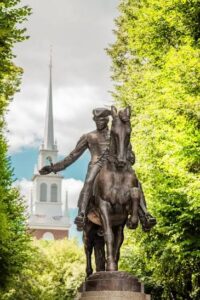
We saw the Boston Commons and the Old State House and the site of the Boston Massacre. We stood beneath the statue of Paul Revere astride his trusty horse in front of the Old North Church. We also saw his house, the oldest remaining structure in downtown Boston. We toured the Granary Burying Ground where Revere and Samuel Adams and John Hancock and other Revolutionary War heroes are laid to rest. Aboard the U.S.S. Constitution—“Old Ironsides,” built after the Revolution and used in the War of 1812–I managed to surreptitiously squeeze my fist through a rope net and toss some tea leaves into Boston Harbor, which has been a lifelong dream.
We did a whole lot of other stuff, too, but I’ve run out of room in this column to tell any more.
(July 11, 2026)