 Just a couple of weeks ago, when the heat dome was trying its best to smother us even after the sun set, I snapped Kamala’s leash onto her collar and set out on a desultory stroll around the block. A neighbor sat in the shadows of her deep front porch, fanning herself with a magazine. She waved me over. “Come sit a minute.”
I told her that as much as I would like to, I couldn’t tarry because I needed to be home before dark. Drivers cut through the once-quiet streets of our neighborhood to get to McDonald’s just a little quicker. Few of them obey the speed limit or seem to be watching for pedestrians.
“Your porch sure is pretty,” I said. “All these ferns and begonias and…”
She cut me off before I could finish. “I’m sick to death of this heat and humidity and I’m sick to death of watering these plants,” she said. “And I’ve got twice as many in the back. I’m ready for summer to be over and for all of them to die so I can throw them out and put a pumpkin on the porch. Just one pumpkin. Which I won’t have to water.”
I laughed so hard I almost dropped Kamala’s leash. Because I agreed with every word she said.
Summer always starts off as my favorite season. I love the slower pace. The emptier calendar. The never-needing a coat or a hat or gloves (or even shoes, sometimes). And there are the flowers, a yard full of flowers, enough flowers that I can always have a big, beautiful bouquet on the table and plenty of flowers to share. One of the first things I did when I moved to my new house and the weather got warm was to plant flowers with reckless abandon. Marigolds. Celosia. Shasta Daisies. Cosmos. Black-eyed Susans. Lantana.
And zinnias. Most of all, zinnias.
I hired a man to till a four-foot-wide swath of ground all the way down the fenceline of my backyard. The fence is chain-link, meaning that anyone walking or riding a bicycle or driving slowly down the street would be able to see and enjoy my zinnias. I smoothed the dirt and planted a ridiculous number of seeds, in every color imaginable. I weeded and watered and babied the sprouts until the first buds appeared.
It wasn’t long before my flower bed was a show-stopper. Some of the blooms grew taller than the five-foot fence. Some poked their heads out onto the other side of the fence. Warm summer temps and copious July rains were the perfect formula for a joyous riot of zinnias.
Then came the drought. And the oppressive heat. And the humidity. Twice a week, I wrestled the hose over to the flowerbed at dusk and watered and watered and watered. Still, the zinnias drooped. They grew moldy. Their leaves curled up and turned brown. Deadheads outnumbered new blooms ten to one. Though bees and butterflies and hummingbirds still showed up, I knew their days were numbered. Numbered just like the remaining days of summer, which I would be exceedingly glad to see end.
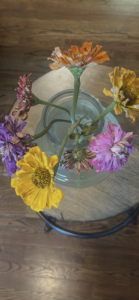
As I finish this column on the final day of September, a pitiful zinnia bouquet sits in the middle of my kitchen island. When it grows too ugly to tolerate, I’ll toss it into the compost bin and put a big fat pumpkin in its place. Just one pumpkin, which I won’t have to water. But I’ll leave the dying flower bed alone for a while because it’s still hard at work. Many of the zinnia seeds will feed the birds during the cold months. Others seeds will fall and nestle into the dirt to become next summer’s flowers.
I’ll be happy about those flowers, of course. But I hope we’ll get a good long break from the tortuous heat before they begin to bloom.
(October 3, 2026)