 Perhaps there’s nothing more boring than a blow-by-blow recounting of someone else’s vacation. Or maybe learning about a trip might be an inspiration to take—or skip– a similar journey.
The first thing I would say about my recent trip to Boston is that eight days and two thousand miles on a bus is long no matter how you slice it. It’s a challenge to get 48 people, senior citizens or otherwise, unloaded for potty and meal breaks and then back on the bus in a timely manner. Our best stops were at Buc-ee’s, because they have lots of clean restroom stalls and countless snack possibilities. Traditional interstate highway rest stops were okay, too. And up north, there were places to stop that had plentiful restrooms and several fast-food choices all in one climate-controlled building.
I won’t write in this column about the not-so-good stops because I’m trying hard to erase them from my memory.
In addition to the Revolutionary War history my travel companions and I found ourselves immersed in, we experienced lots of other interesting stuff. We spent a couple of hours at the Smithsonian Air and Space Museum near Washington, DC, where the IMAX movie about the Blue Angels was well worth the ten-dollar ticket price. We saw the plane the Wright Brothers flew and the long, long Concorde aircraft with little bitty windows and the Space Shuttle Discovery. Most sobering was the Enola Gay, which dropped the atomic bomb on Hiroshima on August 6, 1945.
In Boston, we visited Fenway Park and saw the bar where “Cheers” was filmed and the memorial to those killed in the Boston Marathon bombing in 2013. We also encountered lots and lots of soccer fans, many in kilts but few who seemed overly bereft about Scotland’s World Cup loss to Morocco.
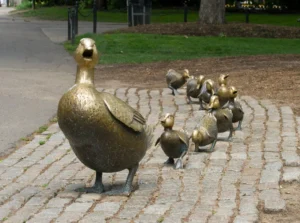
We spent some time in the Public Gardens, where several of the folks on my tour (including me) had our pictures taken with the statues of Mrs. Mallard and her eight babies from the beloved children’s book “Make Way for Ducklings.” As a bonus, we drove by the Boston Public Library, which has 120 copies of Robert McClosky’s 1941 Caldecott winning tale.
Then it was on to a morning in Salem Town, where we strolled by the House of the Seven Gables that inspired Nathaniel Hawthorne’s novel. Because Salem is best known for the witch trials of 1692, I’d watched the movie “The Crucible” shortly before leaving on the trip. That made a visit to an area near the town cemetery, where there are stone benches in memory of all of those hanged, especially poignant.
Next was Cape Ann, where we caught a quick glimpse of the famous “Man at the Wheel” statue (made famous by Gorton’s Fish Sticks) in Gloucester. Then we spent a few minutes shopping in Rockport before a violent thunderstorm drove us back onto the bus.
On day six, the thousand-mile ride back to Tennessee began. I’d grown so resigned to our trip organizer leading the singing of “Good morning to you…good morning to you…we’re all in our places with bright shiny faces” first thing every day that I finally gave in and sang along. For most of the ride, I read or dozed or simply looked out the window and marveled at how wonderfully our driver, Misty, handled the huge bus in never-ending heavy traffic.
Whenever we stopped at yet another McDonald’s/Chick-fil-A/Taco Bell, I reminded myself that I’d eaten a lobster roll in Boston and clam fritters in Mystic and macaroni and cheese with a little bit of crab meat at a restaurant near the Capital Wheel (which I did not ride because I do not like high places) at the National Harbor in Washington, D.C.
Would I travel to Boston on a bus again? Not any time soon. Or maybe ever. But I’ll forever treasure the memories of the trip I took in the semiquincentennial summer of 2026.
(July 18, 2026)