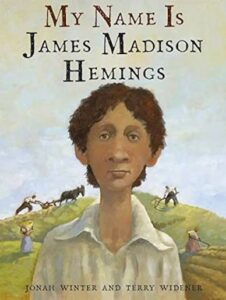
 To celebrate Banned Books Week, which has championed the right to read since 1982, this year I read a new-to-me children’s book. It’s entitled “My Name Is James Madison Hemings,” written by Jonah Winter and illustrated by Terry Widener.
I was led to it by “Brown Girl Dreaming,” a memoir-in-verse by Jacqueline Woodson that I featured in this column just a couple of weeks ago. In it, she wrote that her father’s family could trace their lineage back to a son of Thomas Jefferson and Sally Hemings. That got me to thinking. Were there books that focused not primarily on Sally, but on her children?
An internet search led to “My Name is James Madison Heming,” published in 2016 and geared toward readers ages five to nine. The Putnam County Library has the book—yay!–so I checked it out. Though it hasn’t appeared (so far) on the American Library Association’s frequently challenged books list, the book is not without controversy. It deals with an uncomfortable subject: slavery. That subject is further complicated because it also deals with one of the most revered figures in U.S History.
Thomas Jefferson–writer, inventor, diplomat, statesman, author of the Declaration of Independence and third President of the United States–was a slaveholder. In his lifetime, he owned about 600 enslaved people, all of whom were cataloged in his “Farm Book” among the pages listing his sheep and hogs and other property.
James Madison Hemings was one of Jefferson’s sons. Most historians have long believed that Jefferson had a decades-long “affair” with his enslaved woman Sally Hemings and that he fathered her six children. That’s no longer speculation. Just last month, using a lock of Jefferson’s hair (cut on July 4, 1826, the day he died), scientists concluded that his reconstructed genome matched DNA samples from living descendants of Sally’s sons Eston and Madison.
Yes, that Madison. James Madison Hemings.
If there could be a “gentle” re-telling of the horrors of slavery, this book would be it. There are no auction blocks or whipping posts (though the book does picture an overseer holding a coiled whip in his hand) or bounty hunters with bloodhounds in its pages. Madison points out that he and his siblings did not labor in the fields. He was assigned to the carpenter shop, where he helped build lovely furniture for Monticello. He and his mother and siblings lived not in that mansion, but in a one-room, dirt-floor shack.
Like their father, Madison and his sister and brothers were tall and lanky and had fair skin and red hair. “One night as Mother cooked us dinner,” he says, “I asked her to explain: How could a father enslave his own flesh and blood?” Sally had no answer.
Author Jonah Winter categorizes the book as historical fiction. It was inspired and based upon an 1873 newspaper interview with Madison, in which he summed up his family’s story. Winter writes this in his Author’s Note at the end of the book: “In many ways Thomas Jefferson is one of the most impressive figures in American history…but his life and legacy are full of contradictions. Many celebratory books have been written about him. In writing this book about Madison, I wanted to present a different perspective…and to cast a light on the life of a largely forgotten human being whose story has mainly been swept under the rug of history.”
Upon his deathbed, Jefferson freed Sally Hemings’s children. Madison writes this: “Though Mother nursed our father through his final hours, he never freed her. Not long after Father died, she simply walked away with Eston and me, down the hill, never looking back. And no one ever tried to catch her.”
Do I think this “controversial” book is appropriate for children? Absolutely. And I think it should be in every public library and school in the nation.
(October 10, 2026)